
Estimated reading time: 11 minutes
75% of people aged 70 and over consider sexuality an important part of life’s pleasures – the same proportion as among people aged 18 and over.
What if age – and particularly advanced age – were not a decisive factor in people’s experience of sexuality? This is the conclusion towards which Oui Care’s survey of sexuality among older people points [1]. Differences certainly emerge, but, as we shall see, they remain secondary.
According to an international study, 70% of men and 64% of women aged 40–80 believe that the ability to have sex declines with age [2]. They also believe that sexuality has an upper age limit, which they generally place – that’s where the result raises a smile – within ten years of their own age. In other words, whatever their age, respondents tend to set the limit at a point that does not yet apply to them.
This finding is difficult to interpret. It may reflect a gap between beliefs and actual behaviour, or a reluctance to accept and acknowledge the end of one’s sex life. The Oui Care Group therefore also conducted its own survey of a representative sample of 1,000 French adults aged 18 and over [1]. [1].
Whether or not pride plays a part, 71% of respondents believe that sexuality has no upper age limit, regardless of their own age. This is not the only finding that indicates a broadly positive, uninhibited attitude towards sexuality:
75% think that it occupies an important place in the pleasures of life
72% say they are satisfied with their sex life
88% do not see it as a taboo subject
But what lies behind these overall findings? Do women and men, or younger and older people, approach sexuality in the same way?
Our survey reveals more significant differences between women and men than between the youngest and oldest respondents. Age therefore appears to have less influence than gender on sexual practices and perceptions. Some differences do nevertheless emerge with age, beginning with the frequency of sexual activity.
Frequency of sexual intercourse and advanced age
Although age does not seem to have a bearing on the importance given to sexuality as one of life’s pleasures, it does seem to play a role in the frequency of sexual intercourse.
First, the good news: 75% of people aged 65 and over report being sexually active, compared with 81% across the full sample. 56% have sex at least twice a month, compared with an overall average of 66%.
People in the oldest age group therefore continue to have a sex life [3], although they have sex less frequently than younger groups. 36% of people aged 65 and over reported having sex at least once a week, significantly below the average of 50% across the study population.
These results may be closer to what we would expect. A more surprising comparison, however, challenges the assumed link between old age and an absence of sexual activity.
Comparing the youngest and oldest age groups in our sample showed that a lack of sexual activity is no more common among older people than among younger people. 36% of 18–24-year-olds said they did not have sex, compared with 31% of those aged 70 and over. The proportion of people who are not sexually active is therefore similar at both ends of adult life. What does change among those who are sexually active is the frequency of sexual activity.
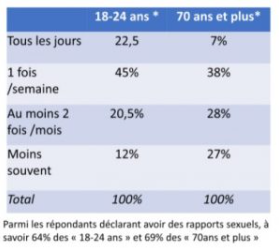
The proportion of people reporting no sexual activity is almost identical at the two ends of adult life. Among those who are sexually active, however, younger people report more frequent sexual activity.
The reasons for not having sex also differ between people in their twenties and those in their seventies. This is unsurprising, given how different their circumstances are. Our study shows that the reasons given for stopping or not having sex are closely linked to the events associated with each stage of life. One factor is common to every age group: lack of desire or libido, cited by an average of 61% of respondents. It is important at every age, although older people place it on a similar level to illness or poor health.
Satisfaction with one’s sex life
Alongside frequency of sexual activity, our study identifies another trend associated with advancing age. Satisfaction is high across the population as a whole: 72% of respondents say they are satisfied with their sex life.
The proportion who are “very satisfied”, however, declines among the oldest age groups. Fewer than one in six people aged over 55 are very satisfied with their sex life, compared with one in four of those aged under 35. Although the importance attached to sex as one of life’s pleasures may remain stable, the intensity with which that pleasure is experienced appears to change [4].
Sexuality becomes more liberated as we age
The study also revealed that sexuality becomes more liberated with age, or at least freer from the pressure to conform.
The clearest finding is that sexuality becomes less taboo with age: 94% of people aged 70 and over do not regard it as a taboo subject, compared with 77% of 18–24-year-olds.
Another revealing finding is that younger adults report more body-image concerns that affect their sex lives: 40% of 18–24-year-olds, 42% of 25–34-year-olds and 46% of 35–44-year-olds, compared with 26% of 60–70-year-olds and 15% of those aged 70 and over. Younger respondents are also more likely to say that such concerns explain an absence of sexual activity: 43% of 18–24-year-olds and 41% of 25–34-year-olds, compared with 18% of 60–70-year-olds and 8% of those aged 70 and over. The irony is striking: cultural ideals celebrate young bodies while subjecting young people to constant, damaging comparison.
Paradoxically, society’s tendency to marginalise its oldest members may also free them from certain social constraints. This does not mean that comparison disappears in old age, still less the negative images and stereotypes associated with ageing. However, these comparisons may operate more at an “intra-individual” than an “inter-individual” level – in other words, older people may compare themselves more with their former selves than with other people. That is one of life’s contradictions: as people grow older, they may become freer from normative and moral pressures, yet repeatedly compare themselves with who they once were – and with what they feel they have lost. They may escape oppressive cultural ideals only to become confined by another unattainable ideal: their former self. In a 1999 interview with Le Monde, Claude Lévi-Strauss described this continual comparison by saying that, at an age he had never expected to reach, and which was one of the most curious surprises of his life, he felt like a broken hologram [5]. Fragments of a whole that still appear complete, even though the whole no longer exists except as an abstraction.
It also appears that, as people age, the ability to let go of familiar reference points – even those that once supported a positive self-image – and establish new ones can help preserve self-esteem. One key to ageing well may therefore be to “free ourselves from who we were so that we can fully enjoy the life ahead” [6]. This process shows how ageing also involves redefining our relationship with the world.
Sexuality and very old age: let us not give in to denial!
Those who believe we are refusing to face reality – that, ultimately, loss prevails and takes with it all libido and every form of sexuality – are not entirely wrong. But we would still need to ask the people concerned, and studies of the very oldest age groups remain scarce. Our own study included very few participants aged 80 and over, and the data-collection method meant that those who did take part were relatively independent.
Studies in English-speaking countries show that the proportion of sexually active people falls sharply in very old age, particularly as health declines [7, 8]. Among those who remain sexually active, however, the proportion having sex at least two or three times a month is relatively stable. Regular sexual activity is therefore possible beyond the age of 80, even if it applies to a minority, and may help people retain their sexual function.
These findings that sexual activity becomes scarcer among very old people nevertheless raise questions. Indeed, what sexuality are we talking about? Genital sexual activity? Masturbation? Eroticism in a broader sense?
After the age of 80, physical health can present significant obstacles. Erectile dysfunction affects more than eight in ten men [9], and some specialists believe that penetrative sex may no longer be possible after the age of 80 or 90 [10]. Isolation and depression, which disproportionately affect older people, can also have a profound impact.
Sexuality may also evolve into other expressions of desire. Colson [11] describes a process of adaptation and acceptance – letting go in order to discover new forms of erotic experience. The “preserved intimacy” she identifies moves away from ideas of power and virility towards a shared emotional experience and greater symmetry between partners. According to Colson, sexual practices not only change but also become more diverse. Psychoanalyst Catherine Bergeret-Amselek likewise notes that in very old age, “more than ever, sexuality draws on the erotic potential of the whole body, beyond genital sexual activity” [10].
by Véronique Cayado
PhD in Psychology, Head of Research at Lab Autonomia
Sources:
[1] Oui Care (2020). Enquête Oui Care sur la sexualité des seniors. Désir, plaisir, sexualité : après 60 ans, la vie sexuelle continue !
[2] Laumann, E.O. & al. (2004). Sexual problems among women and men aged 40-80 y : prevalence and correlates identified in the Global Study of Sexual Attitudes and Behaviors. Int J Imp Res, 1-19 : in Colson, M.H. (2007) [14]
[3] Research on sexuality among older people remains limited, particularly in France (Place des Seniors survey, 2015). Existing data nevertheless confirm that sexual activity continues in later life, although the proportions vary between studies [3, 4, 5].
[4] It would have been useful to compare these findings with overall life satisfaction to determine whether satisfaction more generally also becomes less intense with age. This is a question for future research, particularly given the influence that society’s perceptions may have on the experience of ageing. It is easier to flourish when we do not compare ourselves with others – and especially when we do not compare ourselves with who we once were, or with an idealised version of that former self that the challenges of ageing may lead us to remember more generously.
[5] https://www.lemonde.fr/disparitions/article/2009/11/04/1999-comme-un-hologramme-brise_1262645_3382.html
[6] This phrase comes from a presentation by Marie-Hélène Colson [5], referring to Le Gouès (2000), who distinguishes several ways of ageing, including “compensated ageing”, characterised by a person’s “ability to renew sublimation and creativity” (see Jean-Paul Matot’s review notes, Cahiers de psychologie clinique, 2002, no. 19).
[7] Lindau & al, (2007). A Study of Sexuality and Health among Older Adults in the United State. N Engl J Med, 357 : 762-774.
[8] Lee, D.M., Nazroo, J., O’Connor, D.B., Blake, M., Pendleton, N. (2016). Sexual Health and Well-being Among Older Men and Women in England: Findings from the English Longitudinal Study of Ageing. Arch Sex Behav, 45(1) : 133-44.
https://www.cairn.info/revue-cahiers-de-psychologie-clinique-2002-2-page-181.htm
[9] Pinnock, C.B. (1999) : cité par Colson, M.H. (2007) [14]
[10] Imbert, G. (2012). Évolutions de la sexualité, des désirs et avancée en âge : des regards psychanalytique, médical et sexologique. Entretien avec Catherine Bergeret-Amselek, Marie-Laure Alby & Sheila Warembourg. Gérontologie et Société, 35(140), 193-203.
[11] Colson, M.H. (2007). Âge et intimité sexuelle. Gérontologie et société, 30(122), 63-83.
Leave a comment